Union of Ikigai and the Doctorate Find meaning within academia
Today, more than ever, the world is going through a stage where work, vocation, and self-fulfillment are no longer separate spheres; they are interconnected. This is especially true for those over 35 years of age, as they often have a solid professional background and yet may feel like something is missing. Does this sound familiar? You have likely already accomplished several important goals, and yet you still wonder: Is there something more? What am I doing to leave a legacy?
At that crossroads, the Ikigai method becomes ideal, an ancient philosophy from Japan that invites you to find the balance between what you love, what you're good at, what the world needs, and what you can be paid for. This is the best way to connect these four points in your doctoral journey.
In a review by Indonesia Mengglobal, we find the case of Caitlin Kight, a professor and researcher who immersed herself in what she called her "second doctorate" in education, focused on self-reflection, while also participating in doctoral supervision programs. In this study, she realized at a certain point that many graduate students were facing a crossroads.
“Ikigai is what helps students understand these things about themselves. … For me, I believe this is the foundation of that fundamental human relational aspect in education.”
“What are they supposed to do after graduation? Will they find employment in academia?” This dilemma led her to explore the philosophy of Ikigai, and try to find that balance. For her, the doctorate became more than just an academic goal; it became her way of aligning her passion for helping others with her experience as a teacher and researcher, thus generating real impact.
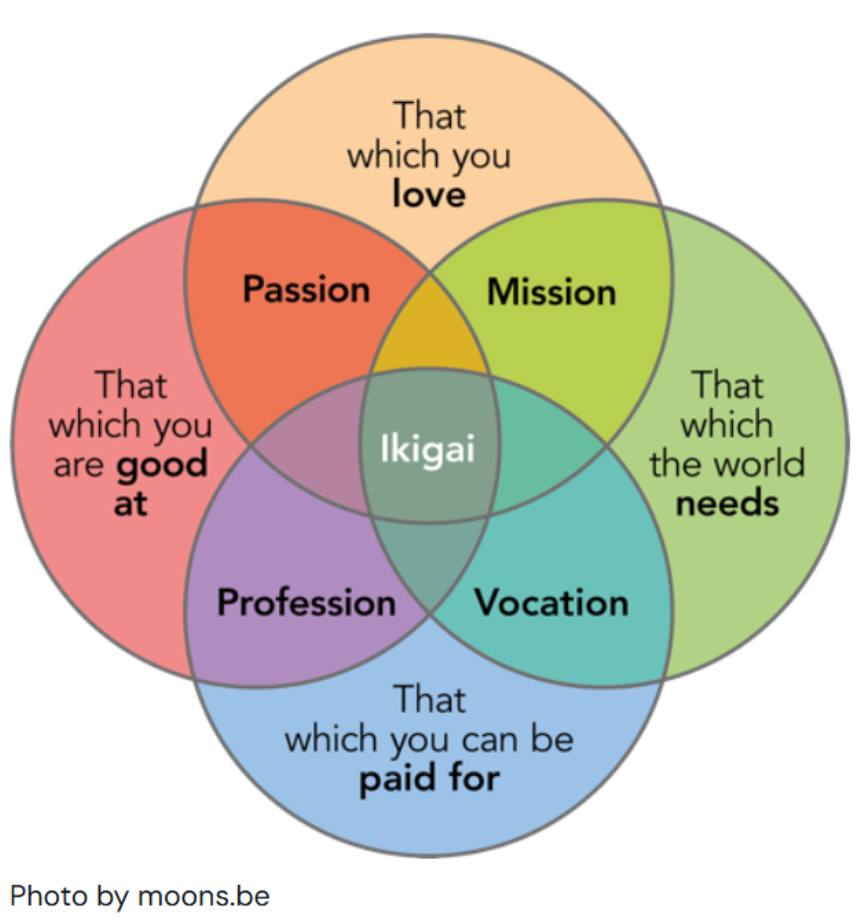
Ikigai as your guiding star toward your Doctorate
Ikigai (生き甲斐) means "reason for being." It’s not simply about finding a job, it’s about building a life with purpose. According to studies published in Psychology Today, those who discover their Ikigai tend to live longer and, more importantly, enjoy better mental health and greater resilience in the face of everyday challenges. Just imagine how your life would change if your intellectual and professional efforts aligned with your purpose.
But wait a moment… What does this have to do with a doctorate or a postdoctorate? The truth is, it has everything to do with it.
A doctoral program is more than just academic tracking. It's an opportunity to research what moves and inspires you, to leave your mark on the intellectual world, and to become a reference in your field of knowledge. It's the route to turn all that passion into something impactful.
Why a doctorate can be a powerful choice at any age
In terms of statistics, you're not alone. According to data from the NCES (National Center for Education Statistics), about 21% of those pursuing distance doctorates are aged 40 and older. In Latin America in particular, this number is growing thanks to the flexibility of online programs and the renewed value placed on lifelong education.
Benefits of starting a doctorate
● Strengthening your professional interests
● Solid source of contacts
● Personal journey that enriches research
● More internal (not just external) motivation
● More effective time management
It’s truly never too late to start, as long as what you want aligns with your purpose.
A starting point where passion and knowledge meet
Many of those reading this surely feel that impulse to deeply study a topic they’re passionate about, but they don’t always know how to begin. That’s where Ikigai is the best option. Take a moment to reflect and respond:
What do you love doing the most?
Identify the topics that ignite a spark in you when talking about them, the subjects you love reading about, or what you would work on even if there were no monetary reward.
What does your environment need?
Observe whether there’s a social, environmental, technological, or educational issue in your surroundings, and how you could contribute.
What can you be paid for?
If you're interested not only in creating impact but also being well accepted and rewarded, look into what skills are needed to align with the labor or academic market.
What skills do you already have?
Through your education, you’ve surely developed skills. Visualize and deepen the ones that will best support you on this new path.
Once you have the answers to all these questions, and they come together into a cause, idea, or theme, you'll have the perfect mix to start your doctoral thesis.
Ways to stay motivated and focused on your purpose
Pursuing a doctorate is no easy feat. It’s a challenging road, full of obstacles. There will be times when you doubt yourself, feel tired, or face demotivation. But if your research comes from your Ikigai, you have a why that is more powerful than any barrier.
Key strategies for this stage:
● Set realistic weekly goals and celebrate when you achieve them
● Build an academic and emotional support system, a mentor, a peer, or study groups
● Don’t forget your purpose, remind yourself constantly, especially on tough days. Write it down and read it when you feel lost,
● Prioritize rest; studying is not synonymous with exhaustion. You can find balance and allow yourself to take small breaks during the day.
The Journal of Doctoral Studies in Latin America (2023) affirms that 58% of students over 35 who drop out of their doctoral programs do so due to a lack of motivation, not due to a lack of capability. You can avoid this by strengthening your Ikigai.
After finishing and graduating: the huge impact of your Ikigai
Once you obtain your doctorate, the path becomes much easier. New horizons open up, not only professionally but also in terms of inspiration. You become an authority in your field of expertise. It’s the moment when your voice can influence, educate, and transform.
What do you do after earning your doctorate?
This is undoubtedly the best part. Once you complete your doctoral journey, new doors open and offer a world of possibilities to develop. These will allow you to create real change, whether in a specific sector or globally. Here are some key ideas:
● Publish your research
● Consider becoming a university professor or mentor
● Lay the foundation for your own research center
● Try to contribute to public policies
● Don’t stop learning, pursue a postdoctorate
Another option would be to join international academic communities, participate in conferences, or collaborate with foreign universities. Knowledge does not stop when your purpose is alive.
Why should you choose online education as your path to success?
Studying remotely is no longer futuristic, it’s the present. The number of Latin American students enrolled in online doctoral programs increased by 46% in the last five years, according to Statista (2024). Some of the main reasons are:
● Versatility for those who study and work
● Access to international universities
● More affordable than on-site programs
● Adapts to your lifestyle and rhythm
If you are someone who likes to commit, stay organized, and has a clear goal, an online doctorate is the best option to reach your goals without neglecting other responsibilities.
Your legacy can start today!
Embarking on a doctorate is much more than obtaining an academic title, it’s a very personal and professional declaration. It’s the most structured and profound way to give extra value to the world through your experience, skills, and vocation.
Now it’s time to reflect: Do you have an Ikigai? What knowledge will define your intellectual legacy? The path to a doctorate is undoubtedly a challenge, but that doesn’t mean it can’t be transformative. And it’s all within your reach.
Dare to start, move forward, and transform your life by leaving a true legacy!